7 Classic Habits of Every White Belt (and How to Fix Them)
The journey of a thousand miles begins with a single step. In Brazilian Jiu-Jitsu, that step is tying on a white belt. It is a magical time full of excitement, confusion, and a steep learning curve. Every black belt you see at Gracie Barra Rancho Cucamonga started exactly where you are. They all made the same mistakes. They all felt the same awkwardness.
Here is a guide to the seven things every white belt does, and how our instructors can help you overcome them.
Jiu Jitsu Classes in Rancho Cucamonga
1. Using 100% Strength, 0% of the Time
This is the hallmark of the new student. You don’t know the technique yet, so you compensate with the only tool you have: muscle. When you get stuck on the bottom, you try to bench press your opponent off. When you are on top, you squeeze with everything you have.
Why it’s a problem: It is exhausting. You will gas out in 30 seconds. More importantly, it hinders learning. If you muscle through a movement, you aren’t learning the leverage that makes Jiu-Jitsu work.
The Fix: Slow down. Accept that you might lose the position. Focus on the mechanics of the move rather than the result. At our Rancho Cucamonga academy, we often say: “If you have to force it, you’re doing it wrong.”
2. The Famous “Death Grip”
You grab your opponent’s collar or sleeve. You hold on for dear life. Your knuckles turn white. Your forearms start to burn like fire. Before the round is even halfway over, your hands are completely useless because your grip is blown out.
Why it’s a problem: You are wasting energy. A grip is only useful if it has a purpose. Holding on just for the sake of holding on limits your own movement and tires you out.
The Fix: Learn to relax your hands. Only squeeze when you are actively pulling or pushing. Think of your hands like hooks, not clamps. Trust us, your forearms will thank you.
3. Holding Your Breath
Watch a white belt spar. You will often see their face turn red, then purple. They are working hard, but they are forgetting the most basic human function: breathing.
Why it’s a problem: Oxygen is fuel. When you hold your breath, you panic. Your brain goes into “fight or flight” mode, and you stop thinking clearly. You get tired exponentially faster.
The Fix: Conscious breathing. In our beginner Jiu-Jitsu classes, we teach you to focus on your breath. If you find yourself holding your breath, stop moving for a second. Exhale. Reset. Calm is a superpower.
4. The “T-Rex” Arm Neglect (Extending Arms)
This is the classic mistake that leads to armbars. You are on the bottom of the mount or side control. You panic. You reach up with straight arms to push the person away.
Why it’s a problem: In Jiu-Jitsu, “safe arms” are elbows tight to your ribs—like a T-Rex. The moment you extend your arms away from your body, you are giving your opponent a gift. You are isolating a limb, making it incredibly easy to attack.
The Fix: Keep your elbows glued to your sides. Use your frames (forearms) to create space, not your extended arms. This simple adjustment will instantly improve your defense.
5. Trying to “Win” Practice
You treat every sparring round like it is the finals of the World Championship. You count how many times you tapped someone. You get frustrated if you get tapped. You avoid rolling with higher belts because you don’t want to “lose.”
Why it’s a problem: Training is for learning, not winning. If you only use your “A-game” to win, you never work on your weak spots. You become afraid to try new moves because you might fail.
The Fix: Leave your ego at the door. Getting tapped is learning. It reveals a hole in your game. At Gracie Barra Rancho Cucamonga, we celebrate the effort to learn, not the scoreboard in the gym. Be willing to tap. It means you are pushing your limits.
6. The “YouTube Technician”
You learned a basic escape in class. But last night, you watched a 15-minute video on a “Flying Inverted Triangle.” So, during sparring, you ignore the basic escape and try the fancy move you saw online.
Why it’s a problem: You are skipping the foundation. You cannot build a house on sand. Fancy moves require a deep understanding of basics—balance, leverage, and timing—that you haven’t developed yet.
The Fix: Trust the curriculum. The Gracie Barra method is structured for a reason. Master the basics first. A perfect basic armbar works on everyone. A sloppy flying triangle works on no one.
7. Being Inconsistent
You train five days in a row. Then you disappear for two weeks. Then you come back and train for three days. Then you take a month off.
Why it’s a problem: Jiu-Jitsu is about momentum. Long breaks kill your progress. You forget what you learned. You lose your cardio. Coming back feels harder every time, which leads to quitting.
The Fix: Consistency beats intensity. It is better to train two days a week for a year than five days a week for a month. Set a schedule you can stick to. Make Jiu-Jitsu training a non-negotiable part of your routine.
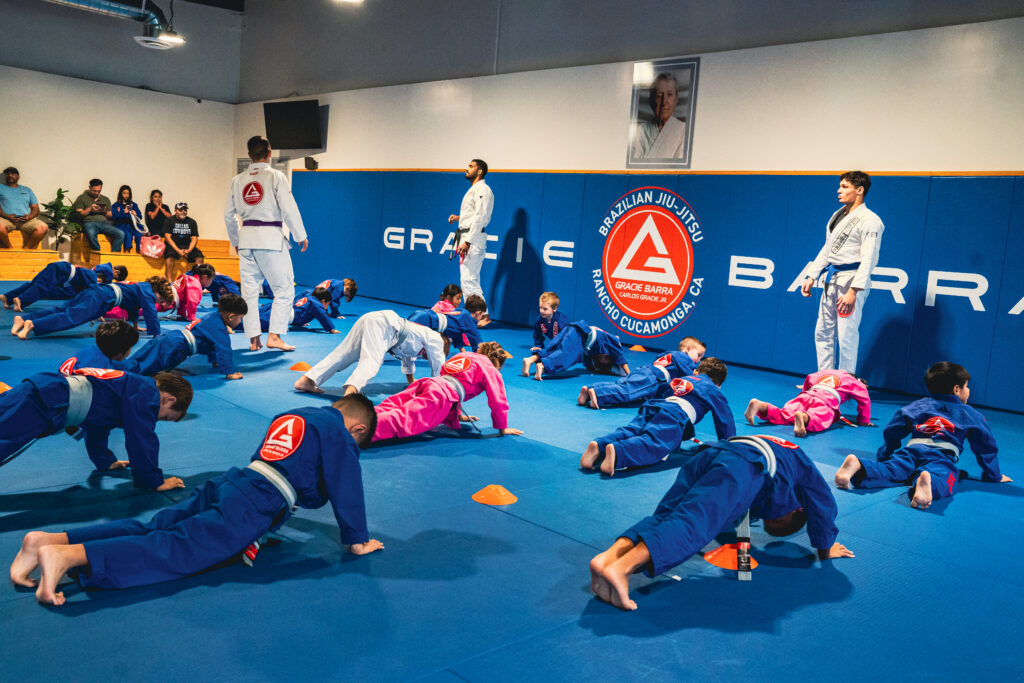
Embrace the Process at Gracie Barra Rancho Cucamonga
If you read this list and thought, “Oops, that’s me,” do not worry. You are exactly where you are supposed to be. The white belt is a time of discovery.
The most important thing a white belt can do is simple: Don’t quit.
Jiu Jitsu Classes in Rancho Cucamonga
Every mistake listed above can be fixed with time and good instruction. That is what we provide. Our professors are patient. Our community is supportive. We are here to guide you from that first awkward day all the way to black belt.
Are you ready to start your journey (and maybe make a few mistakes along the way)? Join Gracie Barra Rancho Cucamonga today. We promise to help you fix those T-Rex arms!